 Escalator Field Guide
 Elevator Field Guide
 iOS
iOSSSPI in British Columbia
The law gives one start date, the regulator gave another, and the date most people quote is wrong. The whole story on one timeline, with every document linked.
When the test is enforced in BC, how the fits inside it, and where every date on the public record comes from.
Two marks to know: explains a term right here. A pill-shaped link, like Safety Standards Act, opens a source document in a new tab, scrolled to the key passage and highlighted, in most modern browsers. A few destinations (PDFs and Technical Safety BC’s site) can’t be auto-highlighted, so those links say where to look instead.
The question this whole page answers: when did the SSPI requirement — and its loaded-gap limit — become law in BC?
June 2003 is not the SSPI date. The version of the code BC adopted then explicitly left the loaded-gap limit out.
1 April 2004: the answer the law gives, and the date to follow. The first day the loaded-gap limit was actually part of BC law, because the regulation taking effect that day adopted the code update that carries it. Working to the earlier date also keeps you on the safe side. You can never be caught under-applying the limit.
15 February 2007: a complication worth knowing about. Technical Safety BC later wrote that SSPI testing began with the code edition that took force in BC on this date. That muddies the water a little, but it does not outrank the law: the Safety Standards Act says that where a regulation and regulator guidance conflict, the regulation prevails, and the directive that named this date has since been rescinded. Plan around 2004; just be aware an inspector may mention 2007.
Every escalator in service gets the SSPI test. A unit’s age changes the numbers it must achieve, never whether it is tested.
How the requirement reached BC
CSA publishes B44-00
The base book of the Canadian elevator and escalator code, CSA B44-00. The loaded-gap limit does not exist yet. It arrives by update two years later. BC takes three years to adopt this book.
SSPI and the loaded gap are invented
ASME publishes A17.1d-2000, an that creates both the index and the 5 mm-under-load gap limit. No legal force in BC yet.
CSA publishes B44-00 Update No. 1
The understood to carry the loaded-gap limit into the Canadian code. BC won’t adopt it for another 19 months.
B44-00 arrives in BC, minus the loaded gap
Allowed to the outgoing code, but BC’s adoption explicitly excludes Clause 6.1.3.3.5, the loaded-gap limit itself, by name.
Old code withdrawn, still no loaded gap
The outgoing CAN/CSA-B44-94 is withdrawn and the BC-modified B44-00 stands alone. The loaded-gap clause is still excluded — which is why “June 2003” does not hold up as BC’s SSPI date.
BC adopts Update No. 1: the exclusion disappears
A new regulation adopts B44-00 with Updates 1–3, and its own list of changes no longer excludes the loaded-gap clause. From this day the loaded-gap limit was part of BC law. The requirement starts here, and this is the date this page recommends you use.
CSA publishes B44-04
The next full edition of the Canadian code, loaded-gap limit built in. BC stays on its modified B44-00 for now. This edition does not become BC law for almost three years.
BC adopts B44-04, the edition the regulator points to
later wrote that SSPI testing entered the code with the 2004 edition, in force in BC from this date. That statement muddies the water a little, but a directive is guidance, not law: the Safety Standards Act settles any conflict in the regulation’s favour, and this directive has since been rescinded. Worth knowing because an inspector may still cite it; not the date to plan around.
One book for two countries: A17.1-2007 / B44-07
ASME and CSA merge their two codes into a single book, ASME A17.1-2007/CSA B44-07. Every edition since covers both countries. BC adopts it more than three years later.
B44-07 adopted, then a nine-and-a-half-year hold
BC skips the 2010 and 2013 editions entirely and runs on B44-07 until 2020, provable from the regulation’s .
B44-10, the first edition BC skips
A new edition of the harmonized book. BC never adopts this one. The province stays on B44-07.
B44-13, skipped too
The second edition in a row BC never adopts. The province is still running on B44-07, now six years old.
The SSPI enforcement push: Directive D-ED 2014-01
BC’s only SSPI-specific document ever issued. It required the test at acceptance (new units and major alterations) and after any step-to-skirt entrapment, explicitly including units installed before B44-04, judged against their own era’s code. Contractors got 60 days to buy the equipment. A , not a regulation.
B44-16 is published
The edition BC runs on today, though it sits on the shelf for another three and a half years before BC adopts it.
B44:19 is out, and BC still hasn’t adopted B44-16
The next edition arrives before BC adopts the previous one. BC never adopts B44:19. It goes straight from B44-07 to B44-16 the following spring.
B44-16, today’s code
The edition in force in BC now. The 2014 directive was as a result — the code moved on, not the requirement.
B44:22 is published
Another edition of the harmonized book. BC stays on B44-16.
B44:25, the newest edition
The most recent book of the code itself, named for its 2025 cycle, released 14 January 2026. BC law still points at B44-16 — three editions back — so B44-16 remains the code that governs BC work today.
One test, two rulebooks
“Every escalator needs the SSPI test, but not every escalator needs the loaded-gap limit. How can that be? Aren’t they the same test?”
They are — the SSPI and the loaded gap are inseparable when the instrument is on the step: one pass always measures both. It’s the unit’s date that decides what to do with the results. Here is the whole trick:
The instrument pass
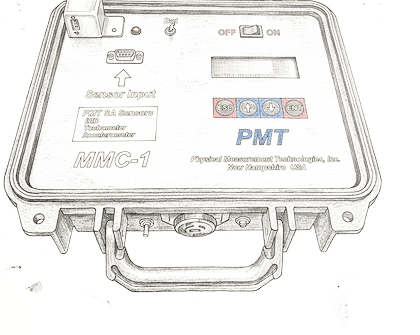
With the escalator running, a plastic test block is pressed sideways from the step against the skirt panel at a set force of 110 N (about 25 lbf) and dragged along. The skirt must not be cleaned or lubricated first — the test wants the panel as passengers get it.
μ — friction
How much the block drags on the skirt: the .
Lg — the loaded gap
How wide the step-to-skirt gap is while that same 110 N is pushing. This is the loaded gap, measured during the pass, not separately.
The index
Both numbers feed one formula, and the result is the SSPI:
Notice Lg is inside the formula, and the same formula appears in the code for existing installations. The loaded gap gets measured on every unit, old or new, every time the index is taken.
Index limit
The SSPI number must achieve a threshold. Modern units: 0.15, or 0.25 with a . Existing installations: 0.15 / 0.4 with a deflector.
+ Loaded-gap limit
The Lg reading also has its own pass/fail line: no more than 5 mm under the 110 N load. This standalone limit is the part that only exists for newer units.
Static clearance
Pre-2004 units aren’t held to the 5 mm-under-load line. Their gap rule is their own edition’s limit, checked without the load.
Which rules bind a BC escalator
Installed before 1 April 2004
- SSPI test: yes. Index measured the same way, judged against the existing-installations thresholds (0.15, or 0.4 with a deflector).
- Loaded-gap 5 mm limit: no. The gap is judged by the static clearance limit of the B44 edition the unit was installed under instead.
- After a step-to-skirt entrapment: shut down and verified against its own era’s code before returning to service (the 2014 directive’s rule).
Installed (or altered) 1 April 2004 or later
- SSPI test: yes. Judged against the modern thresholds (0.15, or 0.25 with a deflector).
- Loaded-gap 5 mm limit: yes. The Lg reading has its own pass/fail line at 110 N.
- Alterations count: a major alteration puts a unit under the code in force at the time of the alteration.
≤ 0.4 with deflector
≤ 6.4 mm total
BC ran B44-94 + B44S1-97 until 2003
≤ 0.4 with deflector
≤ 6 mm total
BC: 1 Jun 2003 – 31 Mar 2004
≤ 0.4 with deflector
≤ 7 mm total
BC: 1 Apr 2004 onward
≤ 0.25 with deflector
under the 110 N load
These rows are keyed on the CSA B44 edition a unit was installed under, not on its installation year. That is how the code itself sets them out, in the “NOTE (on CSA B44 Requirements)” carried by ASME A17.1-2016/CSA B44-16 against the step/skirt clearance requirement. Check the edition on the unit’s code data plate rather than working back from the year: BC’s adoption dates are documented from 2003 onward (B44-00 mandatory 1 June 2003, Update 1 on 1 April 2004), but its adoption dates for earlier editions are not published. In the first three rows the gap figure is that edition’s static clearance, measured with no sideways load. Only the last row uses the loaded gap. The index thresholds are the code’s existing-installations rule (0.15, or 0.4 with a deflector) and the modern rule (0.15, or 0.25).
A note on the American figures. The same code book carries a second, parallel note for ASME A17.1 editions, with different numbers, including a 9.5 mm allowance for units installed under A17.1-1971 through A17.1-1979, and a bucket that folds in ASME A17.3. Those belong to the ASME sequence only. BC has never adopted ASME A17.1 on its own, and has never adopted ASME A17.3. Neither appears in B.C. Reg. 101/2004 or in the former B.C. Reg. 28/90, which ran CAN/CSA-B44-94 with Supplements 1 and 2. So the 9.5 mm figure and A17.3’s flat 4.8 mm have never applied to a BC unit.
Or let the app work it out
The Escalator Field Command app determines these values automatically: give a unit its installation date and it shows exactly which thresholds apply — this table, applied for you, for BC and other jurisdictions.


How the test is enforced in BC today
- Routinely: SSPI is part of the recurring periodic test cycle under today’s code (B44-16, requirement 8.6.8.15.19), which BC adopted by regulation.
- Historically pushed hard: from 2014 to 2020 the directive also demanded it at acceptance and after every step-to-skirt entrapment, with real teeth (60-day equipment deadline; non-compliant escalators “will not be put into service”).
- Hierarchy: where guidance and law disagree, the Safety Standards Act (s.30(4)) settles it — the regulation prevails. The directive is rescinded; the regulation-adopted code requirement stands.
- What BC has never published: an SSPI limit table. Ontario has, and it is the clearest published example of the thing BC leaves unwritten: TSSA Advisory ED-300-21 sets out four bands of pass criteria keyed to the date a unit was registered, and spells out what makes a test chart invalid. It has no force in BC. It shows what a published answer looks like. The only BC-published SSPI figures appear as narrative in one incident investigation (the figures sit under “Investigation conclusions”). For a binding answer on a specific unit, ask Technical Safety BC.
Every source behind this page
- This is a research summary, not legal advice. Adoption dates and enforcement practice change. For a binding answer about a specific unit, ask Technical Safety BC or your authority having jurisdiction.
Want every codebook edition BC has adopted, not just the SSPI question? BC's Elevator Code Adoption Timeline covers the full history.
See the full timeline →Working to the escalator code on the job?
Escalator Field Command carries the Escalator Field Guide: the escalator code in plain English, searchable and offline. It does not cover the SSPI history on this page.